Where this comes from
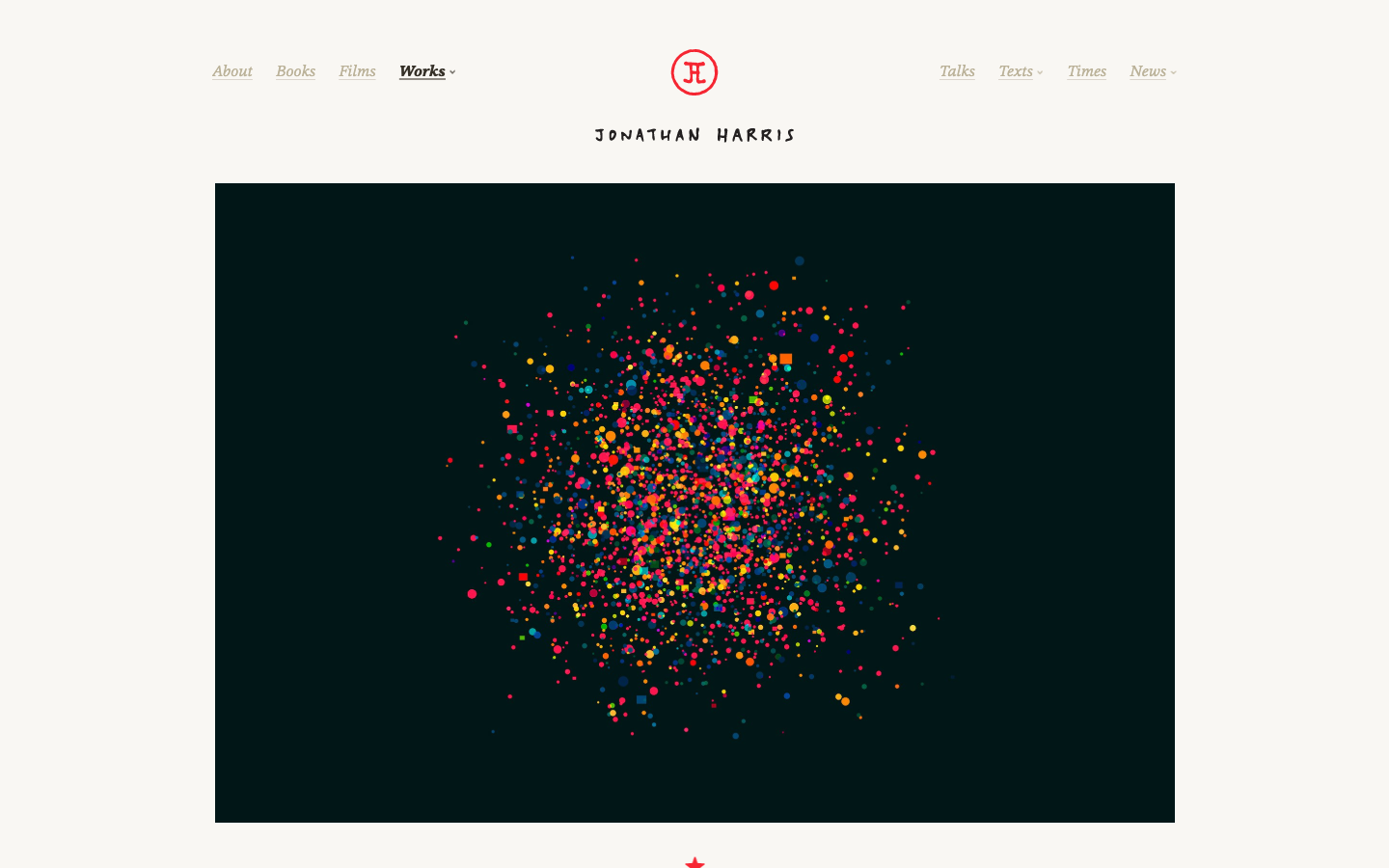
In 2010, at design school, a teacher showed us a website called We Feel Fine.
It was reading blogs every ten minutes, hunting the words “I feel” and “I am feeling”, and drawing whatever it caught. Thousands of sentences from strangers, moving. I had never seen code do that. I had never seen data look like weather.
I fell in love with it immediately, and I decided that one day I would make something like it. Back then that meant learning to write it. I could only dream about describing a thing to a computer and watching it appear, without a single line of code in between.
It is 2026 and I have the tools. This piece is what I could not build in 2010. The Voices in my Head, and this whole site, is dedicated to Jonathan Harris and Sep Kamvar, and to what they showed me sixteen years ago. Their original was a Java applet and no browser on earth will run it any more, which is its own kind of sad. Harris keeps it alive as a thing you download and install, which is a strange afterlife for a piece about the whole world talking at once.
This is a love song. To the technology, to graphic design, to art, and to holding on to a thing you saw once and could not do yet.
The idea
One clock. Two clicks a second, a pen, and it never changes speed for as long as you stay.
Everything that appears lands on that click. A colour comes up, a photograph arrives, a word appears, a face changes, the hour types itself. Nothing inside the piece is allowed a clock of its own, which is why it feels less like a website and more like something being counted out at you.
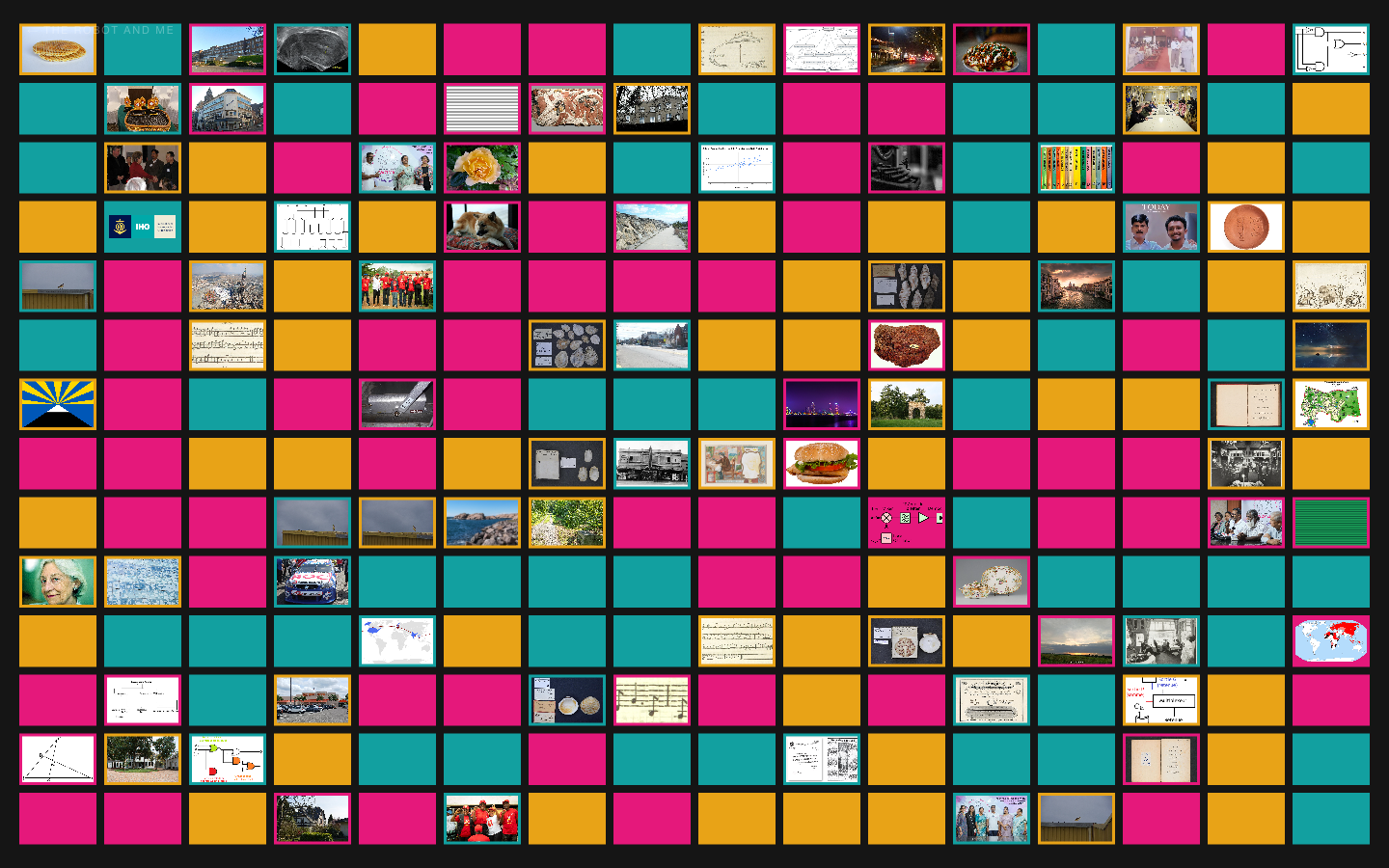
It gets worse on purpose. It starts as one thing at a time. Then it runs three things at once, then four, and it never goes back down. After that, one more thing is wrong every round and nothing is ever repaired: the wall of pictures is found already fallen, the sentences break apart, the clock starts lying, the word STOP gives up and turns into MORE.
You cannot fix any of it. There is no pause, no volume, no way to slow it down. The only control you are given is a small X, and one screen where you can throw tomatoes.
“It does not get more varied. It gets more crowded.”
None of it is mine
Most of what arrives on the screen is scraped live, while you watch, from places that had no idea they were making art.
The photographs come out of museum and library archives. The sentences come from four websites at once, taken in strict rotation so no single voice can own the screen: people arguing on Hacker News, Wikipedia stating facts flatly, people on Mastodon talking about their day, and people on Stack Exchange telling each other they are wrong.
The dreams are real dreams, posted publicly by people describing what they saw in their sleep. The film is public-domain footage from somewhere between the 1910s and the 1980s, and it tells you the year underneath. The people afraid of losing their work to a machine are real people saying so in public, quoted word for word, with the date and the place under every line and no name. The edits are every change being made to every Wikipedia on earth, right now, as they happen. The earthquakes are every tremor the ground has made in the last hour.
The live material is not chosen and it does not repeat. Nothing is stored. I never see any of it before you do, and neither does the piece: it asks, it takes what comes back, and it puts it on the beat.
A few things are fixed, and those I did choose: two product photographs, a small set of skies, and five seconds of a woman crying. They come back every round, and I saw them long before you did. Everything else is a stranger, arriving once. That is the part I find beautiful and the part that makes me nervous, and both feelings are the work.
The one thing that never breaks
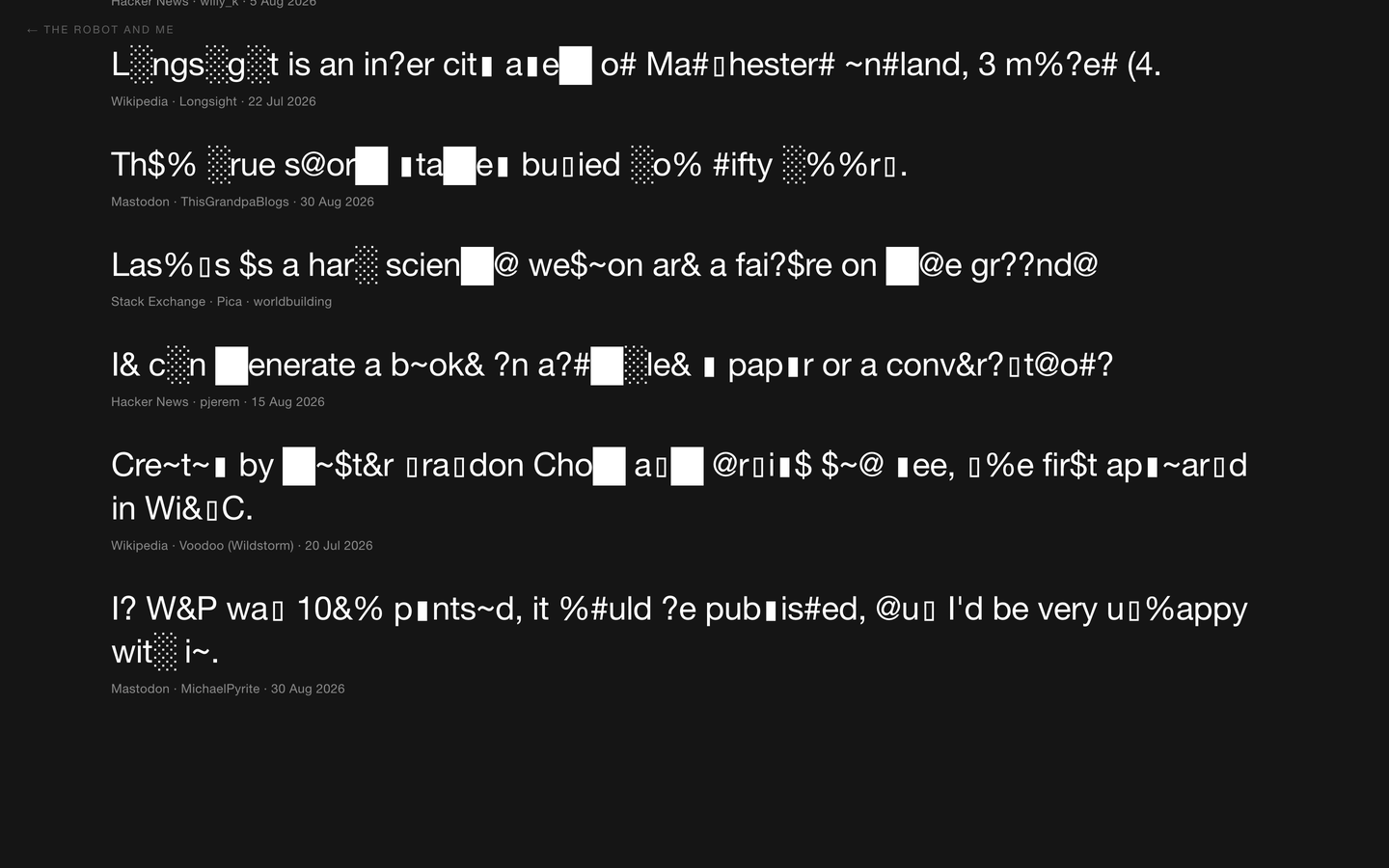
Under every sentence there is a line naming when it was said and where it came from. That line never corrupts.
The words above it dissolve into blocks and noise as the rounds go on, further every time, until there is no sentence left to read. The citation underneath stays exactly true. A piece that has lost the ability to say what it means still has to say truthfully where it got it.
The sentences name who said it as well, with two exceptions. Wikipedia gives the article instead of a person. And the people afraid of losing their work to a machine are given no name at all, deliberately: somebody saying in public that they are frightened for their livelihood should not have their name set under a crying face on my website. The date and the place stay, and the words are theirs. The one thing I change is a dash. An en or an em dash inside a quote becomes a comma. That mark is banned everywhere else on this site, and I decided the quotes should not be the exception.
That is not a technical decision. It is the only rule I would not break, on a piece whose whole subject is other people’s words arriving unasked.
What I got wrong
I asked for the wall to collapse while you watched. The machine built it and it was an effect, not a fact.
Nothing falls now. You arrive and it is already down, and you never see it happen, which is the difference between watching a thing break and finding it broken. That correction was mine and it made the piece better.
The other way round happened too. I wanted every round to be different; the machine argued that different is not the same as worse, and that a piece about being overwhelmed should get more crowded rather than more varied. It was right and the whole back half of the piece is built on its argument.
And the material bites. Reading what had actually landed on the wall, rather than looking at it, turned up things I would never put on this site. The pictures now come from three places only: Wikimedia Commons, Europeana and iNaturalist. It is a floor, not a guarantee: nothing here inspects an image, it only reads what the archive says about it.