Concept
This is the experiment where I went back for something I lost. In 2010 I built a memorial website for my final project at Shenkar design school. It ran, it got written about, and then it disappeared, and what it disappeared into was the exact thing it had been built to argue about.
The idea was one sentence. Every memory is a light.
You post a memory here and it does not arrive as a post. It arrives as a light, and it lifts off and joins a sky already full of them. Almost none of that sky was posted, and where it came from is further down this page. A soul is a firefly, which is what vagalume means in Portuguese. The firefly was never decoration. It was the logic of the whole product, and it is still the logic now.
Darkness was the other half of it. Darkness is not death in this thing. Darkness is everything nobody said out loud.
“Memories. Fragments of precious moments in our lives , spent with our loved ones. When a person you care for passes away, the memory of him lives on in your mind and soul. But memories can be forgotten or even lost if not shared with others . Join us and share your memories with the world...”
Where it started
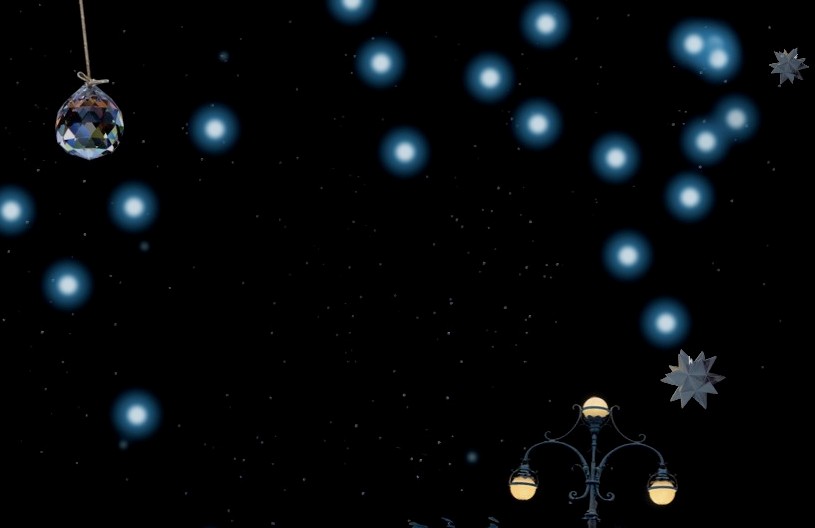
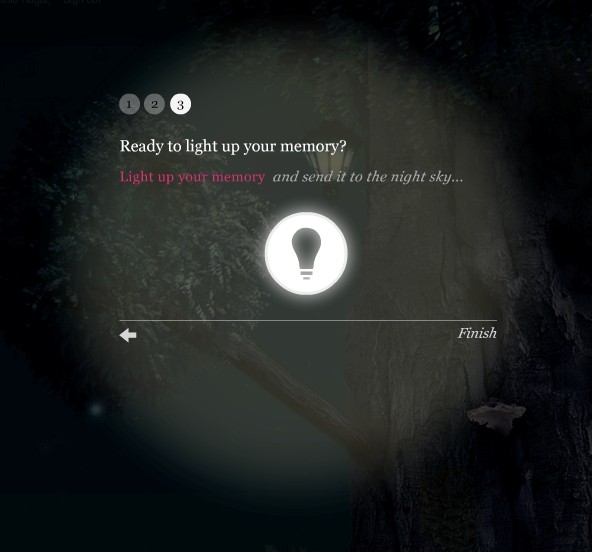
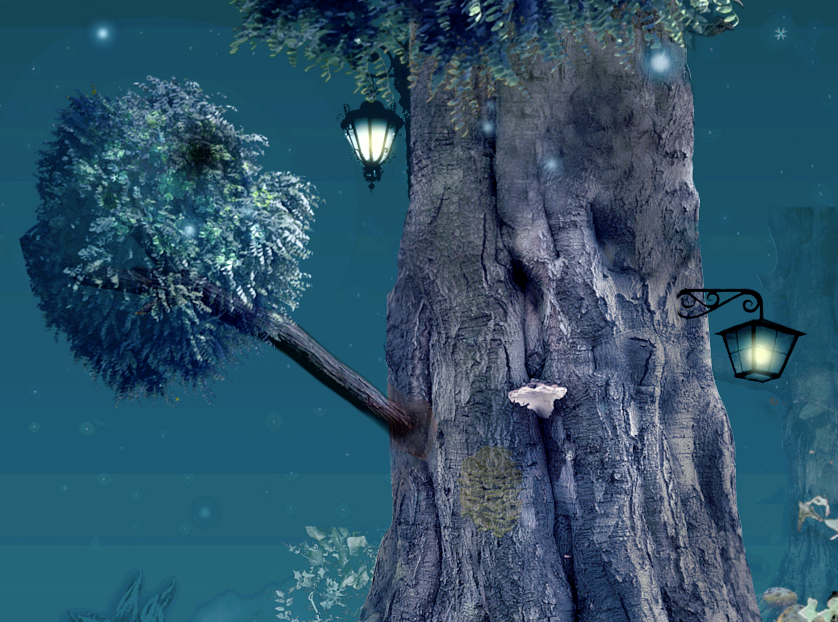
I wanted a sky you could move through. One light for every memory, gathered into constellations by the person they belonged to, and you could search it and filter it and hover a light to learn whose it was. I wanted memories that knew about each other, so one could sit next to another and say they were related. I wanted the form you fill in to be a circle of light you hold over a dark garden, so that writing about someone was itself an act of lighting something.
Some of that got built. A final project gets the time a final project gets.
What ran was a demonstration. The memories in it were invented and the people in it were invented, and the counter along the bottom edge was counting things I had made up so a visitor could see what a full sky would look like. That was honest work for a student project and it is the correct way to show an idea. It is also the reason the thing could not be what it was describing. It was a picture of a system, and a picture of a system holds nobody.
What was lost
No code. No assets. No layered files. Not a backup, not a copy on a laptop, not a zip in an email to myself.
The entire project was one Flash file sitting on an external drive. The drive is gone. Flash is gone. There was never very much to lose, and that is the part I keep going back to: it was one file the whole time.
“While the presence in the physical world is temporary, the presence in the virtual plane is eternal and everlasting.”
That was the thesis. I said it out loud, in an interview, the year after I finished the project. Then the project went first.
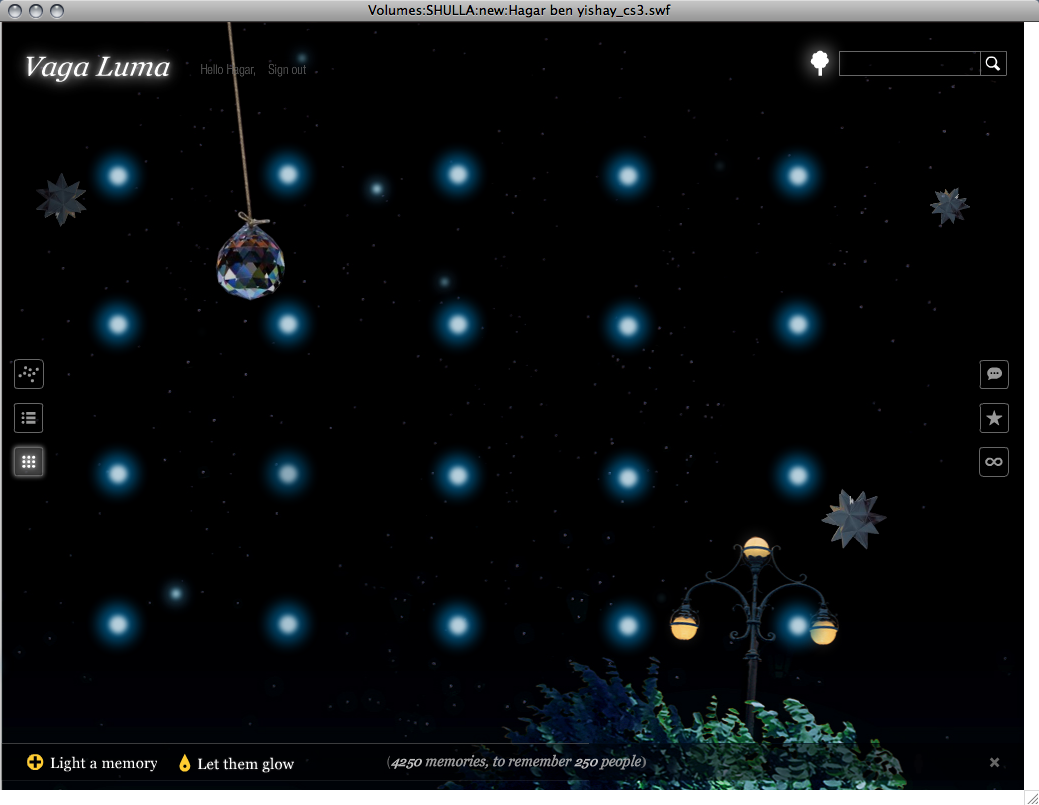

One thing survived, and only because I had put it somewhere else. A walkthrough recording, five minutes and twenty six seconds of somebody moving through the world with a mouse. I put it on Vimeo. It is still sitting there.
How it was read back
The machine took the recording apart.
It pulled the file down, cut it into one frame per second, and read the 326 stills in order, screen by screen, until it could write the design back down. Every screen. The words on them, exactly as they were typed. The three steps of the create flow. The colour of the lamp light against the colour of the night. The fact that the cursor was a cut crystal hanging on a string.
The output is a document dated 4 July 2026, and it opens by saying what it is: no original code or assets survive, so this document is the reference.
I want to be accurate about what that was worth, because it is easy to overstate. The video is five and a half minutes long. I could have watched it. I had watched it. Watching is not the same as writing it down, and it turns out the thing I actually needed was not a memory of the project, it was a specification of it. The 2026 build was made from that document, not from me.
The rebuild
The 2010 sky held whatever I put in it, arranged the way I arranged it.
The 2026 sky is computed from a corpus: 413 people, and 23,715 memories. All but one of them were already written on public memorial pages before I got there, and I copied them from where they were. Nothing in it is invented. Nothing in it is mine. My job stopped being to fill the world and became to build the thing that holds it, which is the job I wanted in 2010 and could not reach.
Not a restoration, because there is nothing to restore. A return.
“Of course, if I had the resources and time –I would happily return to the project, to delve deeper into it and improve the experience of wandering the world.”
I said that in 2011 and then did nothing about it for fifteen years, because the resources never showed up. When they finally did, they were machines.
What is still open
It does not open on a phone. The site measures the window and puts up a notice instead of itself if it is narrower than 900 pixels or shorter than 500, so turning the phone sideways does not get you in either. A family reading this on the way somewhere cannot get in, and a memorial that closes on the device people actually grieve on is a memorial with a hole in it. That is a decision I made and it is not a good one yet.
The dates in the corpus are written two different ways. I never cleaned that up. I taught the site to read both, so anything I build later that sorts or filters by date has to know the same trick or it breaks. The mess is still in the data. I worked around it.
And I have read a small part of what is in there. The machine has read nearly all of it, and there is a remainder neither of us has reached. One person cannot read a corpus this size, which is a fact and not an excuse, and it is the thing about this project I am least at peace with.