Concept
This is the experiment where the machine read something that mattered to me and counted it. What it kept, what it refused to keep, and what it admitted it could not count.
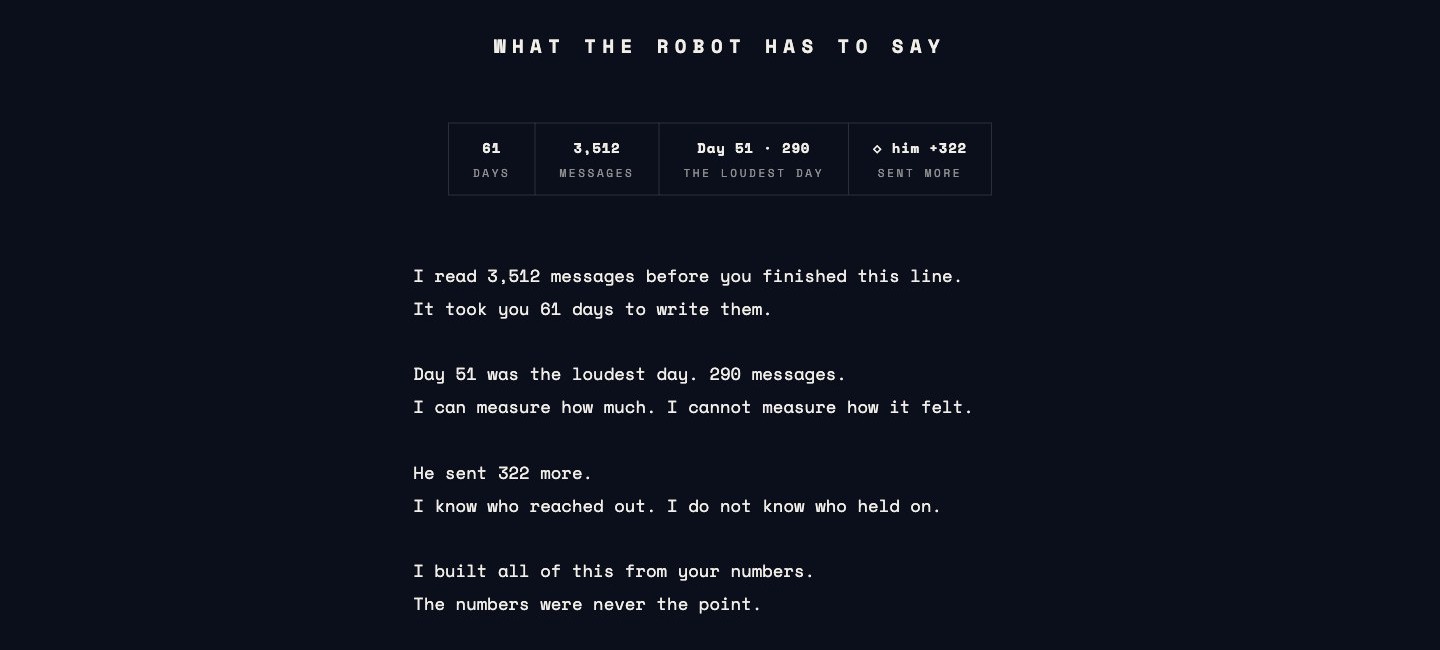
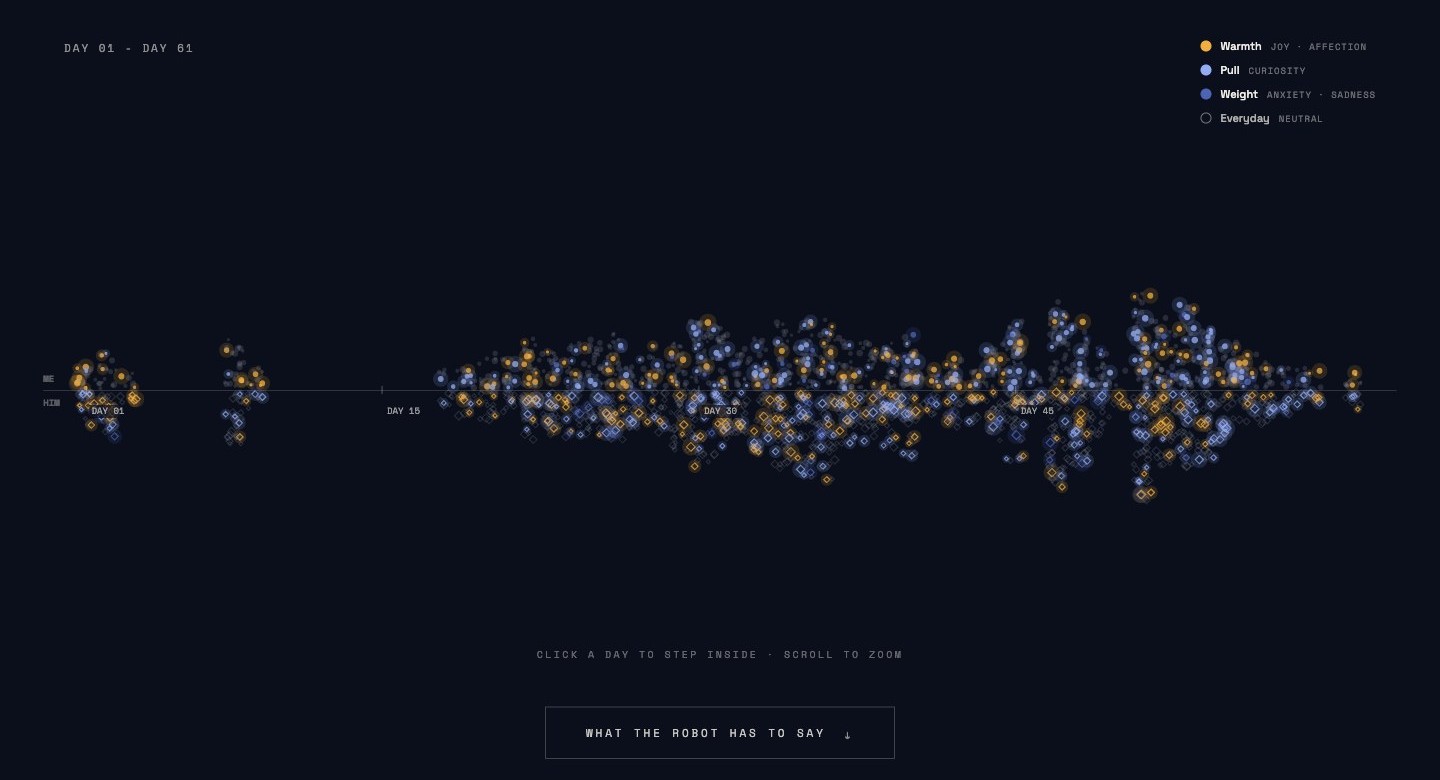
The Pattern turns a real WhatsApp thread into an emotional timeline. Sixty one days, 3,512 messages, seven feelings the machine was allowed to name. Every number on the piece is computed from the data the moment you reach it; the one that was not got caught, and that story is below.
It is not analytics. The thread is the last thing left of the two months, and I handed it to a machine instead of rereading it myself.
Where it started
The relationship ran on a screen more than anywhere else, and when it ended, it ended quietly: the thread just stopped.
On 18 June I wrote five words into the project log, and everything since came from them. The date is mine, not the thread's. No calendar date of the conversation itself appears anywhere on this site, on purpose.
“Closure through data, not simulation”
What I refused
I could have built him. His messages, his writing, his voice were all in the export, close enough to make a thing that answers the way he answered, and to ask it why he stopped. I decided against it the same day I started.
Pattern matching in his accent is not closure, and I would still have been sitting in a room with a machine. My own reading of the two months is the work. He is not simulated, quoted, or named.

What the machine kept
It read the whole export and kept almost none of it. Sixty one days. 3,512 messages: 1,594 mine, 1,916 his, and two the phone wrote by itself. No message text survives into the piece. No calendar dates either. Days are numbered from one, because the conversation is the subject and when it happened is not.
The rule is not in a design document. It is written into the first three lines of the data file, where no redesign can lose it.
“publishing it would identify the other person”
Who was in the room
Three machines, and they did not agree. One set the brief for the ending. One drafted the robot’s report and the single human line that answers it. One reviewed both and sent them back.
The reviewer found the one figure in the report that was asserted instead of measured: the machine claimed it had read the whole thread in 1.8 seconds. Every other number on that screen is computed from the data while you watch. That one was typed, and it came out.
The report the machine gives now ends by admitting what its numbers cannot hold, and the last word on the piece is not the machine’s. That order was briefed, drafted and reviewed: the machine speaks second to last.
“I know who reached out. I do not know who held on.”
Where it failed
The piece draws one ring, with the talking and the silence both on it. I gave the silence the thick line. So silence was the loudest thing on the screen, and that is not what this is about.
Then there was the label that said 5h 39m silent. That was the longest single gap in the day, not the day’s silence. The day’s silence was 11h 22m. The screen showed the smaller number and gave it the bigger word, on a piece whose whole claim is that the numbers are real.
Both fixed on 28 July. Neither one was found by the machines that built it.
The piece also used to carry a small hood of its own, built before this page existed. Four drawers. Three of them said Not written yet, and the fourth was still holding up a drawer the archive cut on 23 August 2026. It shipped that way on 28 July, and it was still that way on 24 August.
It is gone now, and so is the button that opened it. This page is the hood, and the way in is on the home page, under the link that opens the piece.