Concept
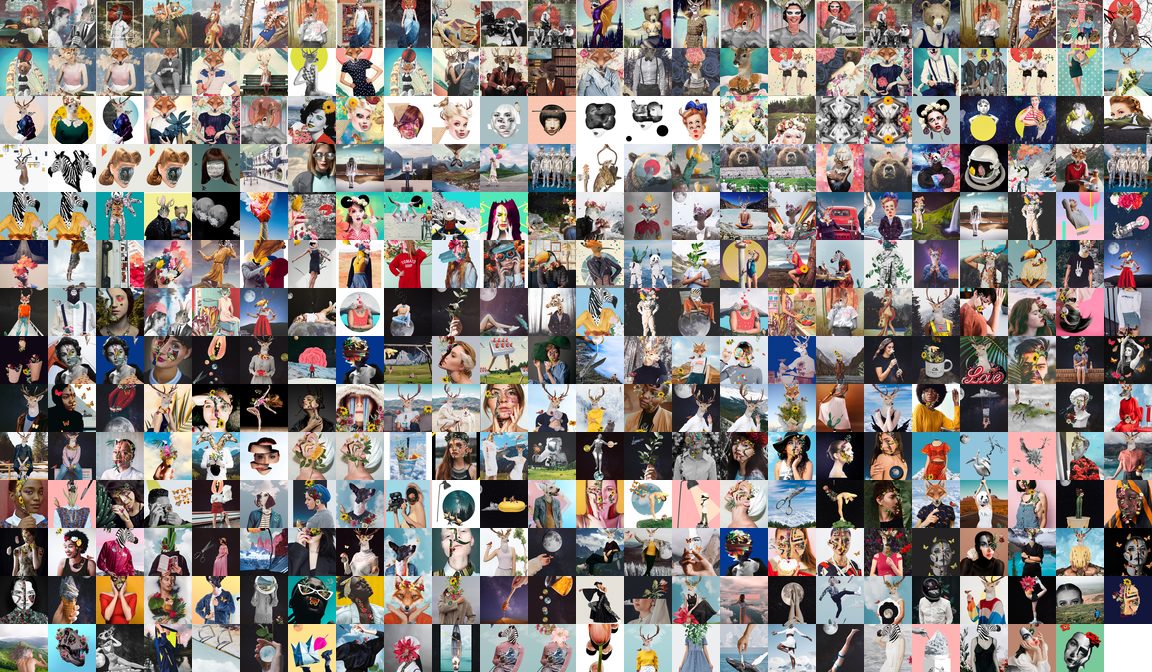
An archive is not a folder. It is a body of work read as one piece. The timeline is the frame that makes 335 fragments one thing.
None of it was cut with a knife. Every piece was made in Photoshop, out of material that already existed: stock images I bought, and real magazines. That makes them ready-mades. It was already photographed, already printed, already sitting in somebody else’s library. My work was choosing it and setting it next to something it had no business being next to. The computer cut and pasted. Nobody asked it to invent anything, and in 2012 it could not have. That part was mine.
A folder is where you put things so you can stop thinking about them. I had a lot of folders. What I didn’t have was the thing you only get when you put 335 pieces next to each other and let them argue: a shape. I’d never seen mine.
So this isn’t a gallery and it isn’t a portfolio. Nothing here was chosen. Everything that got through is on the page, including the pieces I’d quietly leave out if it were up to me.
Where it started
For years the work lived in folders. Some on the old laptop, some in Dropbox, some on a Tumblr. When somebody asked to see my art, I sent them the Tumblr link, because it was the closest thing I had to a whole. It wasn’t a whole. I’d never once looked at all of it in order, start to finish, and I didn’t know what it would say about me if I did.
The Tumblr was never the archive. It was the part of the work that happened to have a URL, which is a different thing, and for years I let one stand in for the other.
The oldest file in here is dated 16 February 2012. I don’t remember making it. That’s the part nobody warns you about. An archive doesn’t only show you what you made. It shows you what you forgot you made.
“find all of it, put it in order”
How it was gathered
I gave it the folder and one sentence: find all of it, put it in order.
That was the whole brief. No favourites, no best-of, no me. I’d been the one choosing since 2012, and choosing is how some of it ended up in a folder called Hagara Stuff 2014 and the rest ended up nowhere.
Then it started asking things I’d never thought to ask.
It read every file’s own creation date, and that’s what put them in order. The year it took from my folder names, and when a file’s date argued with the folder by more than a year, the folder won.
Which is the right way round, and it took me a minute to see why. A file date tells you when the file happened. It doesn’t tell you when I made the thing that ended up in it. Those names were the closest thing I had to that, and I’d written them myself, one folder a year. In 7 of them I capitalised the S. In the other 4 I didn’t.
Then it put every image next to every other image and pulled out the near-copies, keeping whichever file was biggest.
And then it built a gate, which is the part I didn’t expect to feel anything about. Under 500 pixels on the short side, or a sharpness score under 160, and you don’t get in. Not because it’s a bad piece. Because it falls apart the second you make it bigger.
18 didn’t get in. 12 too soft, 6 too small. The softest scored 53.1 against a floor of 160, and no, I didn’t argue.
335 stayed.
Nothing was thrown away, though. All 18 are still on the list, each one carrying the number that removed it, because I wanted to be able to come back and argue later if I felt like it. You can’t argue with a folder you’ve already emptied.
3 ways in
One body of work, 3 ways in, because I didn’t know which one would tell the truth. Archive is the flat wall: all of it at once, in order, no story laid on top. Timeline walks you through it year by year. Spread tips the whole thing loose on the sheet, like paper on a table, and the piece you click grows toward the middle while the rest of the deal clears away.
The years aren’t evenly loaded and I didn’t want that smoothed out. 2018 holds 104 pieces. 2022 holds 4. What happened in between is the part I don’t have a good sentence for yet.
I didn’t want a chart. A chart turns it into somebody’s finding, with an axis and a claim attached. Setting each year numeral at the weight of its own year leaves it as the work, sitting at the size it actually is.

What I sent back
I don’t review by reading. I look. On 25 July I sent 8 screenshots back with 8 things wrong on them, numbered. The year rail was sitting on top of the works. A red frame came up on hover doing nothing the lift wasn’t already doing. And one view was called Table, which it is not. You don’t read a table like that. You tip it out and look at it. It’s a spread. All 8 closed the same day, the red frame is gone, and the hover is the lift and the caption and nothing else.
Calling a thing by the wrong name is the fastest way to lose an argument with yourself. Table was wrong for weeks, and I couldn’t say what irritated me about that view until I said the word out loud and heard it.
The red frame is the one I still think about. It was doing nothing the lift wasn’t already doing, and it had been on the screen long enough that I’d stopped seeing it. That’s the real cost of looking at your own work every day.
“counted six bodies. counted six heads. none of the pairs match.”
Where it failed
The homepage printed 2012 to 2022 in one block, and Ten years, 335 pieces a few hundred pixels below it. 2012 to 2022 is eleven years. The page was arguing with itself in the open, and had been for days. Nothing replaced the span word. The range and the count were already on the page. Publish the range and the count. Never the arithmetic.
“a bear, wearing glasses. i stopped trying to explain it.”