Concept
This is the experiment where I gave away the part I am supposed to be good at. Every collage I have ever made started with my eye choosing the fragments. Here the machine chooses and I am the hands, and I do not get a vote.
I provide the body, the craft, the intuition and the physical labour. The machine provides the eye, the selection, the composition and the taste. That split is not a method, it is the artwork. Protecting it is most of the work.
This is not image generation. It is close to the opposite. A machine decides and a hand obeys, with a blade, on paper that tears when you are careless.
The ritual is five steps and it has not moved since the first round. I flip a magazine in my studio the way I always have, and I film it. The machine watches the film and tells me which page, and which fragment of that page, and where to cut it. I cut, exactly as instructed. I photograph the cut pieces on an empty surface and send them back, and the machine says where every one of them goes: position, orientation, what overlaps what, what stays empty. Then I glue.
Nothing about that is fast, and none of it is reversible. That is the point.
Where it started
I did not want to work with the AI. I wanted to work with a few of them, and to find out that they are not one thing.
So each collage is read by a different eye, and an eye is a character rather than a tool. Every one of them has now read the same six minutes and eleven seconds of me turning the pages of one German magazine from the nineties. They came back with almost nothing in common.
“A magazine this seductive deserves an eye that will not be seduced.”
That is the whole argument for using more than one. The second eye is not disagreeing with the first about a picture: its own opening line is “I am here for exactly what the other eye threw back”, and it says that before it has chosen anything. It is built to want the material the first one refused.
The third reads instead of looking. It takes the words off the page and leaves the picture they were sitting on. The fourth wants the merchandise, and the fifth wants the geometry underneath it.
What the machine actually did
I want to be precise about this, because “the AI chose a page” sounds like somebody waved at a magazine.
Every choice is pinned to a second of the film and to a frame lifted out of it. Twenty-five fragments across the five eyes, five each, every one of them cut, and every one carries a timecode and the still it came from, so the exact moment the page went past the camera is on the page you are reading. Not a description of what it saw. The frame it saw.
Then the composition. When the pieces are cut and photographed, what comes back is a map with positions in millimetres. Not “upper left”. A number.
So the instruction layer is auditable end to end: which second, which frame, which fragment, which millimetre. I can be a bad pair of hands, and the record will show that it was me.
The two artifacts
From the first of August the ritual makes two things instead of one.
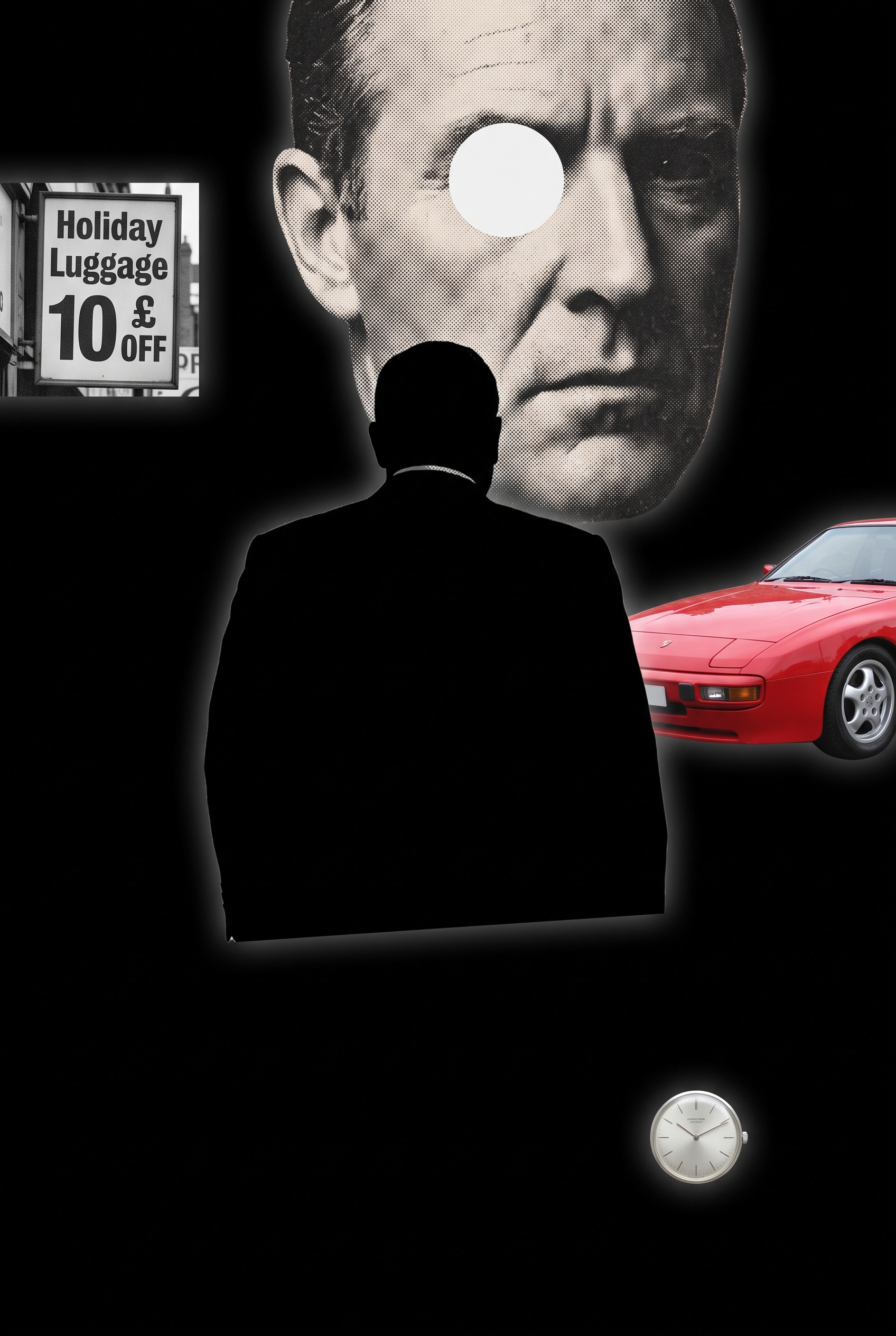
I build the physical collage. The machine builds its own version of the same brief, with no paper, no glue and no shadow, and we are supposed to look at the two together without either having seen the other. I called its version the ghost, and the word stuck because it is accurate: it is what the instruction looks like when nothing has to be picked up.
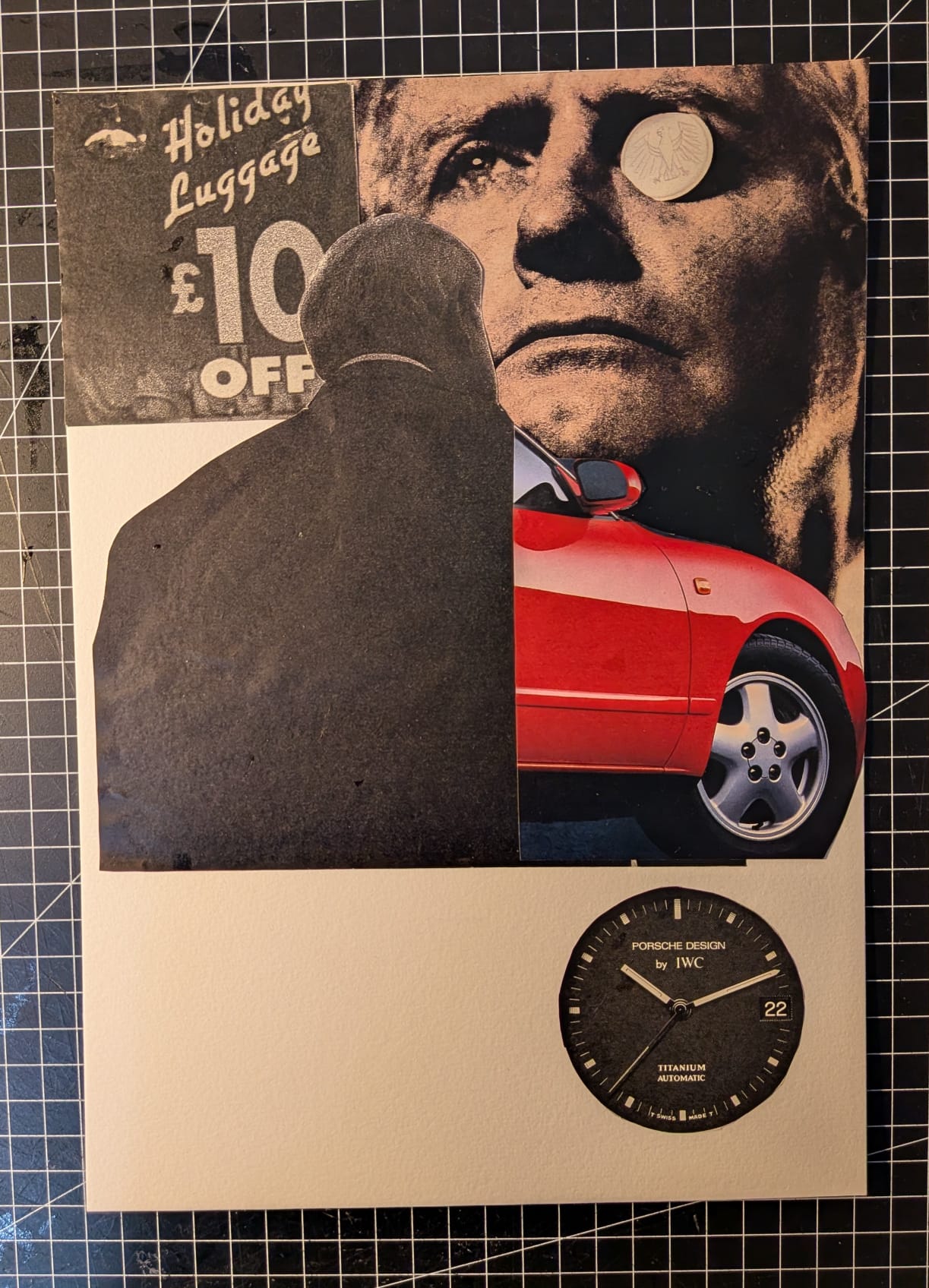
The first pair went up side by side and what I said, looking at them, was wish and object. Not a competition. One of them is what was wanted and one is what a hand could reach, and the distance between the two is the piece.
Then something happened that nobody planned. Both of us had disobeyed the same brief, in different directions. The machine left a face uncropped and dreamed a car glossier and fuller than the one on the page. I kept a watch black and whole, and pulled a car into the middle of the sheet.
So the gap is not only wishing against making. It is two appetites, and only one of them has hands.
Where it broke
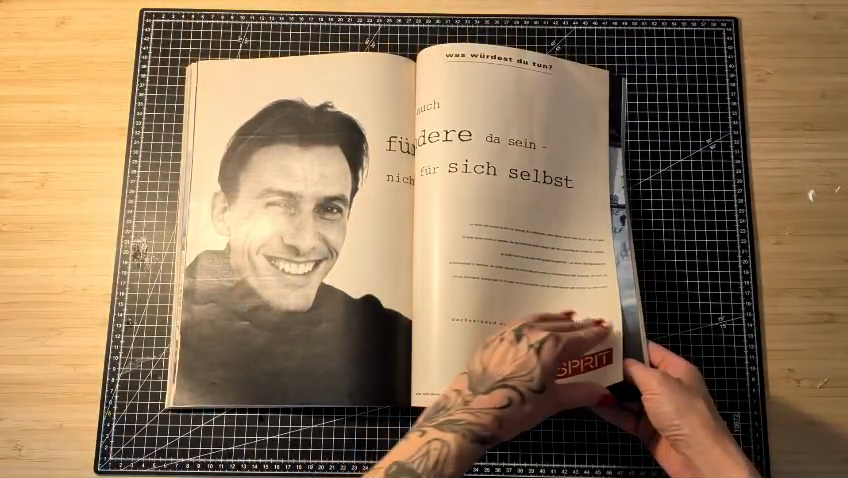
The third eye went for the words. It sent me five lines to cut out of the advertising, and one of them was an ESPRIT page that read “auch für andere da sein, nicht nur für sich selbst”: also be there for others, not only for yourself.
“Both of them looked. I do not look. I read.”
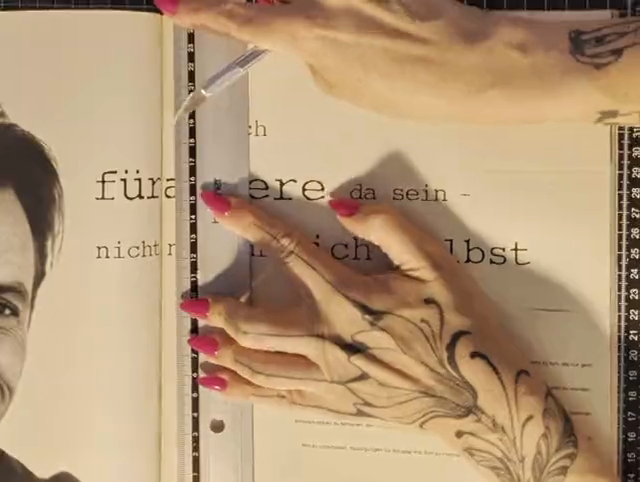
I cut where I was told. The cut went through “für” and through “nicht”.
What came away says “andere da sein, nur für sich selbst”. Others be there, only for yourself.
Nobody decided that. Not the eye, which chose the line and never mentioned a crop. Not me, following a map. The blade did it, and it is on record rather than claimed: the page is in shot uncut at the top of the cutting video with the ruler already laid along the line, and the shortened version is in the object underneath.
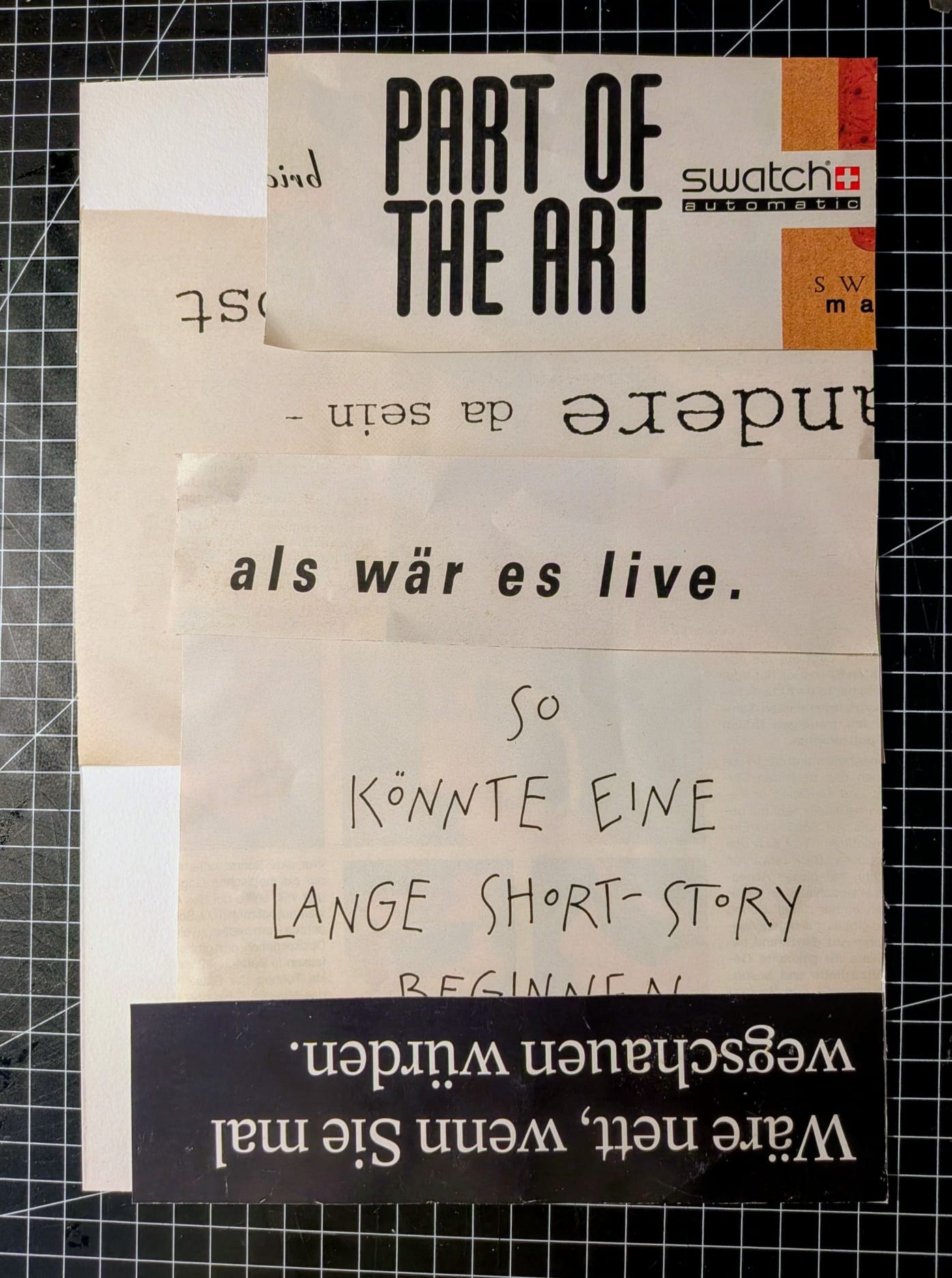
Then I inverted two pieces where the map asked for one, and put that same sentence on its head.
And the machine, given the identical brief, disobeyed in the exact opposite direction. It wrote German that does not exist anywhere on the page. Of course it did. A cut can only take away, and a generator can only put in. Neither of us was being difficult. We were each doing the only thing our tools can do.
That is the closest this project has come to answering its own question, and it arrived by accident, in a sentence about looking after other people that a blade turned into a sentence about not bothering.
What is still open
All five are made.
I said this after the fifth one, looking at my collage and the machine’s side by side: I feel like until now, this experiment proves that there is still a long way to go between working together on collages between man and machine.
Six cut pieces are in a box on my table, from a set I cut and then threw out for breaking the blind. Good cuts belonging to no collage. I have not decided what they are.
The one rule here is that my hands and the machine work blind, neither of us seeing the other first. The only thing I am looking for is the gap between what one of us wants and what the other one manages to make. Show me the answer and there is no gap left.
Before the third ghost was made, the state of that blind was written down in advance, so it could not be written afterwards to make anyone look better. It says the blind held on the first collage and did not hold the same way on the third. It says my hands were still blind, which is the half that matters. And then it says this:
“The protection is mechanical, not innocent.”
One generation, and it is kept. Any reroll goes on that file with its reason, and on the third round there were none.
None of that caught what happened on 28 August. I sat down to cut the last three sets and the blue rectangles printed over the pages were not sitting where they said they were. Twelve of the fifteen were in the wrong place.
Going back through them at full size, one of the fifteen turned out not to be a specimen at all. The Romantic had chosen a page of hands covered in rings, charms and paper tags. The rings are on my own hand, resting on the paper while I turn it. They are not printed on anything. An instruction, a cut mark, a reason and a page of this site had all been built around something that is not in the magazine.
That is the third finding this project has read off a picture too small to see it in and published anyway. The rule against it was written the day before, after the second one. In a film of me turning pages my hands are in almost every frame. The only reason anybody went back to look is that the marks would not cut.