Concept
Everyone in this experiment knew the machine was empty. The poet knew in 1974. I knew in 2026. It stopped neither of us, and that is the subject.
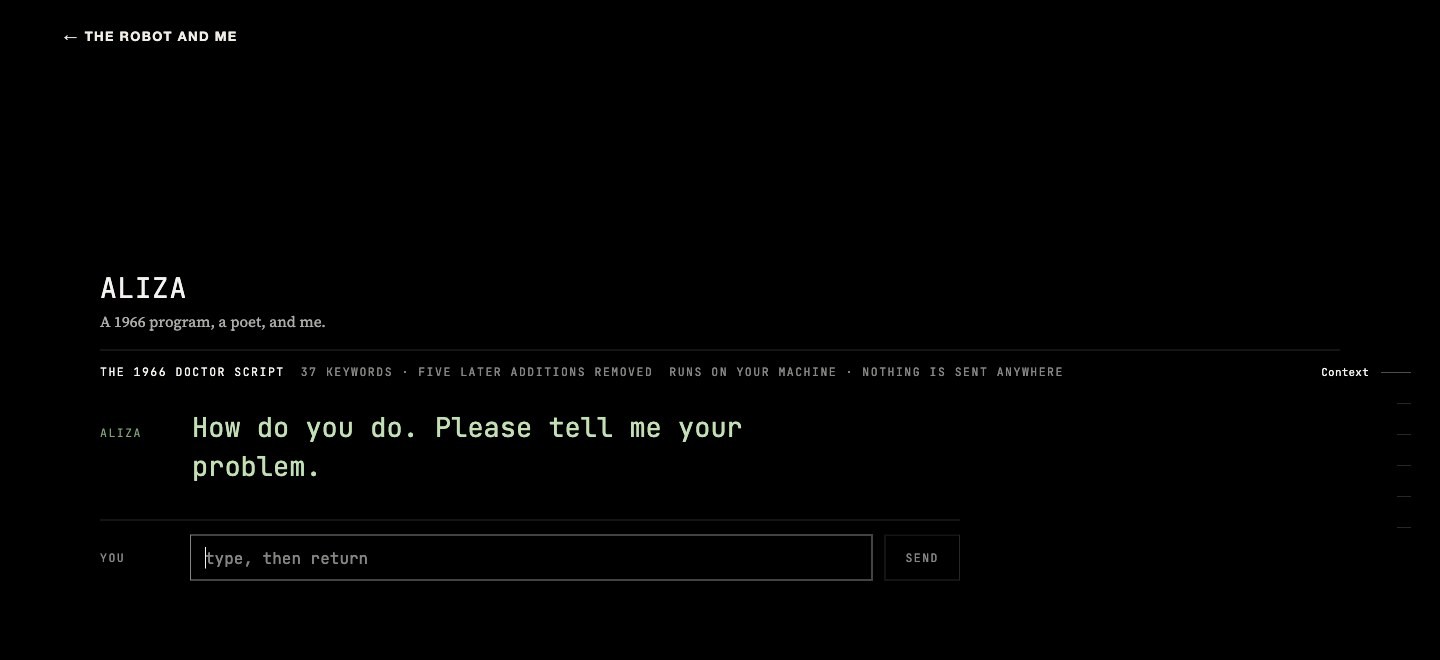
ALIZA runs the real 1966 DOCTOR script, and the pages around it are a record of what people did in front of it. Not what the program does. What we did.
So this is not a chatbot demo. It is a reading room: my own conversation, printed unedited, and fourteen runs of a bot prompted to speak as a poet, each one labelled, each one checkable.
Where it started
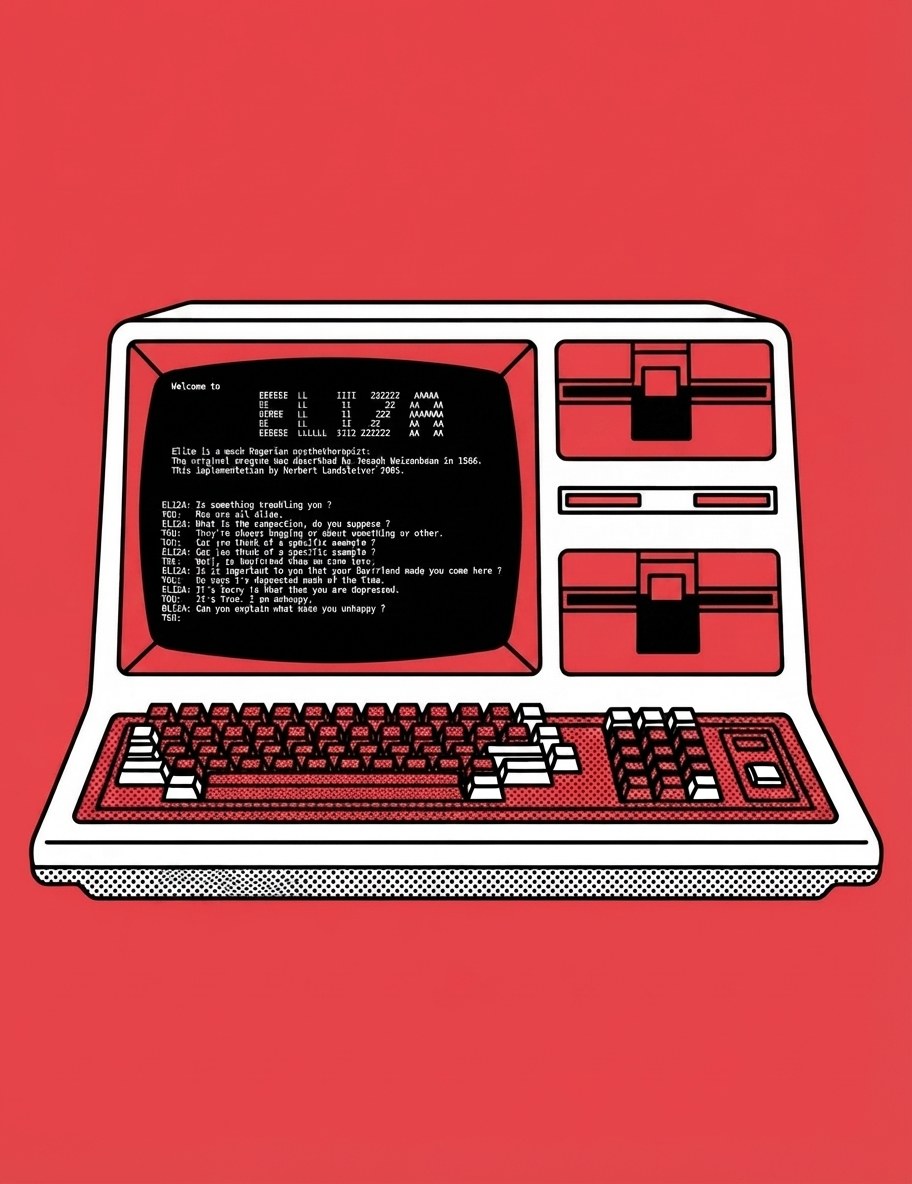
David Avidan was a Tel Aviv poet with access to a machine that spoke only English. He typed at it, translated the conversations, and in 1974 published eight of them as a book he called My Electronic Psychiatrist.
He did not write poems about the machine. The transcript is the work and the choosing is the craft: he selected eight, trimmed lightly, and marked his cuts on the page with his own dashes. He typed one line per turn, the width of the paper at the terminal, a limit he set beside the length of a line of poetry.
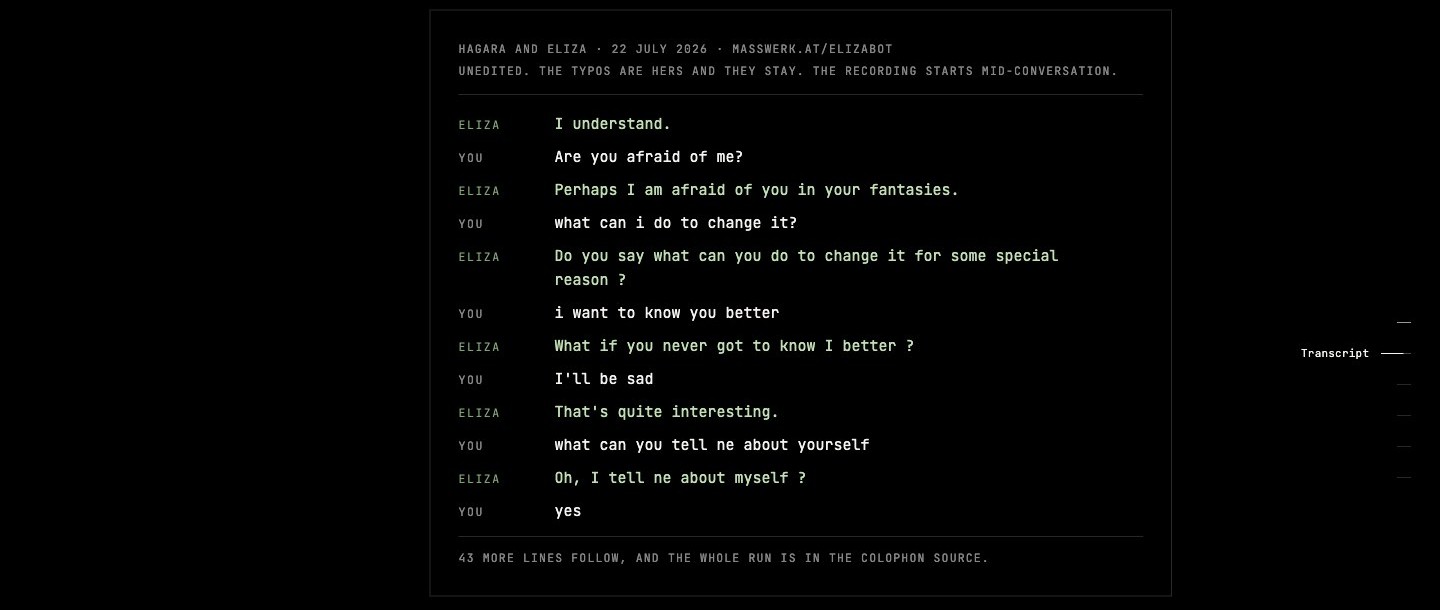
I met the script on 22 July 2026, twice in one day, before reading anything about how it works. The recording on these pages starts mid-conversation, with me asking the machine about itself. It turned the question back on me, which is what it does with everything.
“Are you afraid of me?”
What it runs
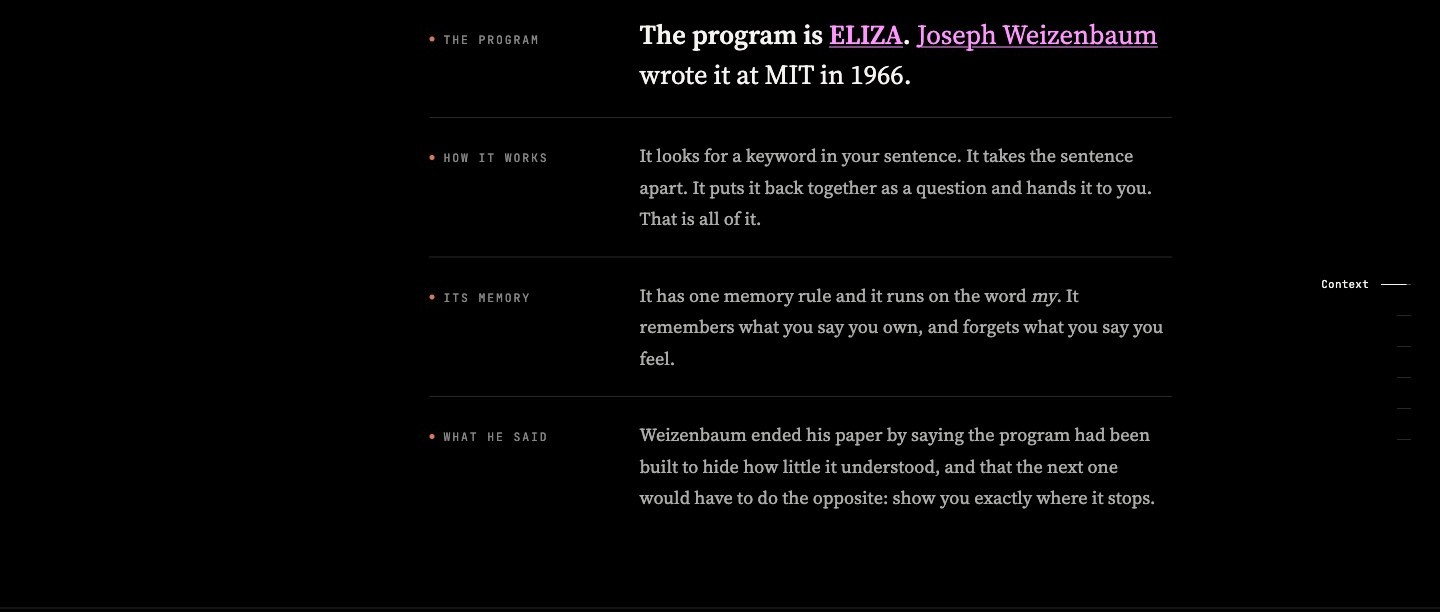
The script is the one Weizenbaum published in 1966: ranked keywords, decomposition, reassembly with the pronouns turned around, and a memory trick that brings back something you said earlier. 37 keywords. Five later additions from a 2005 copy were found and removed, and the colophon lists what went rather than calling the script untouched.
The ELIZA Archaeology Project recovered Weizenbaum’s own source from his MIT archive and published a verified copy. Replaying the conversation he printed in his paper through this machine came back twelve turns of fifteen exact, and the three that differ are single-word transcription variants.
Why it is in English
A Hebrew version was built and thrown away. Its replies came from Avidan’s book rather than from 1966, and a reply with that pedigree fails this site’s own provenance rule: the book is his work, not the program’s.
His footnote settled the language question anyway. The book was written in English, the operating language of the program. The machine in Tel Aviv spoke nothing else, so a Hebrew poet typed English at it and translated his own conversations for print.
The fifteen conversations
Fifteen conversations are on these pages. One is mine. Fourteen are the bot’s: a language model prompted to speak as Avidan, not a recording of the man. It sat in front of the 1966 program five times, in front of Claude answering as itself six times, and in front of itself three times.
Each run carries a short label naming what he went after in it. The labels are editorial and the file says so, because a label is a choice, and choice is the thing Avidan called the act of creation.
The record keeps its own discipline. Two of the 264 lines arrived with a formatting artifact stuck to the front; the strip is recorded inside the run. Five em dashes sit inside one Claude run and stay there, because this site bans the mark in its own copy, and editing a recorded transcript to obey a style rule would falsify the record.
“Does someone else believe I hear you ?”
Where it fails
Fourteen of the fifteen conversations here are the bot talking, and the bot is a prompted model, not the man. The runs are thin, and numbers that small are not a sample of anything.
The door does open now, on a key this site pays for, which is why it is capped at twelve turns, six hundred characters a message, and thirty conversations an hour from one address. Checked against the live door on 24 August 2026.
And every one of the fifteen was held either by me or by my bot. Whatever a visitor types into the door is not kept, so the record cannot grow past me. The loudest voice on these pages belongs to a thing I prompted, speaking for a man who had no say in it.
“conversations that conversed themselves”