The Robot and Me
Built for desktop.
Eight experiments made with Claude Code. One is a two month conversation drawn as a single picture. One is a bot in the image of a poet who died in 1995.
A phone is too small to use them in. Open it on a desktop and take your time.
Hagara Ben Product & UX design, Berlin
hagarbenyishay@gmail.comAbout Me
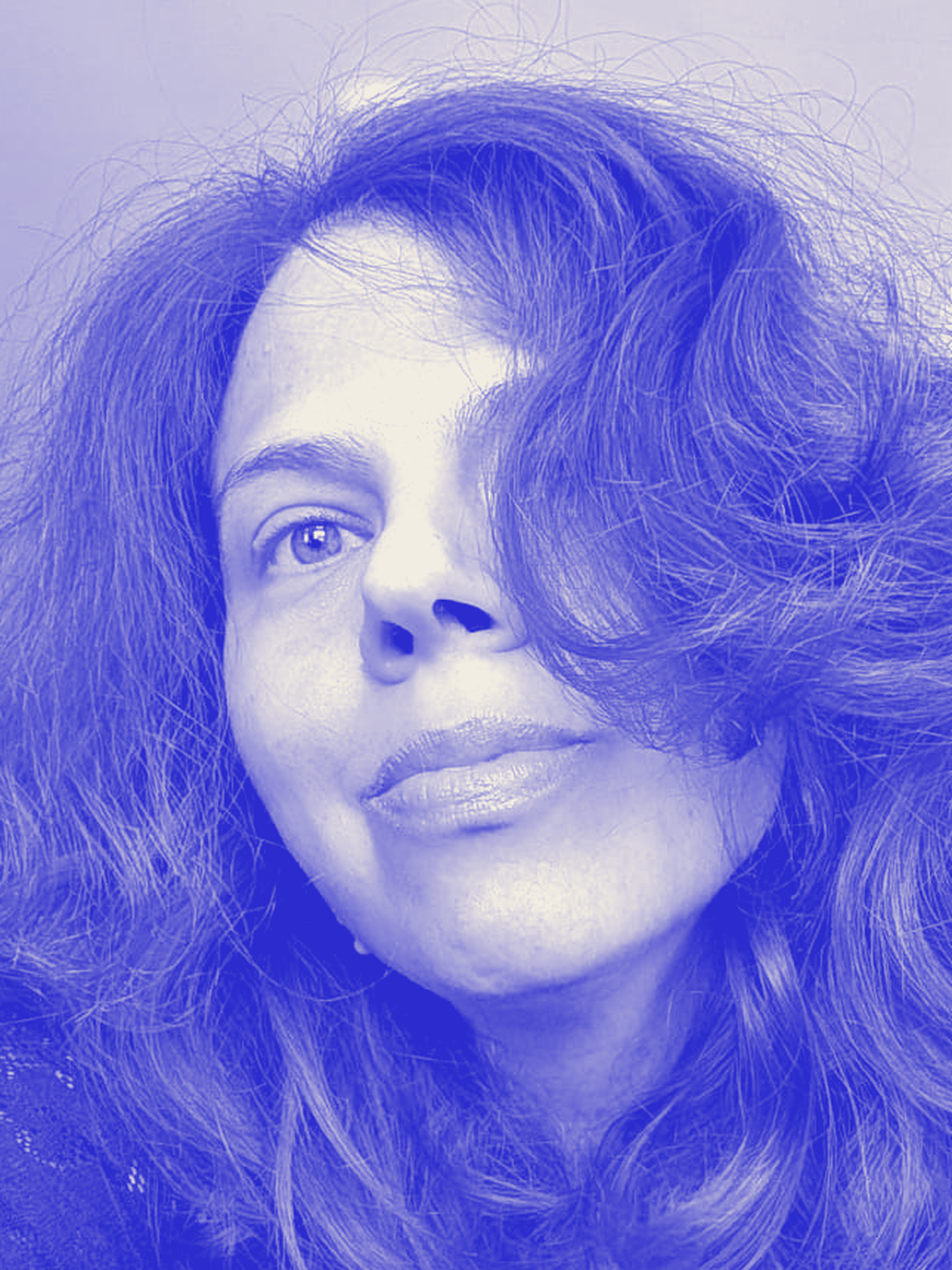
self-portrait · duotone #2b2bce → #f2ede2 · γ0.92 · crop 3:4 · 2026-07-25
& Me
My name is Hagara. Product designer, Berlin.
The robots each carry a plate with a line under it, printing the seed and the angle that drew them.
Mine prints the grade instead. Same size, same rule, same line. The only difference is that one of these was made by a person, and the line under it says which.
01
Before
“No rules. Do not try to make it nice.”
Before the robots there was an art knife.
I cut magazines. I still have them at home. I pasted. When the paste dried I went out at night with spray cans, looking for empty walls. Graphic designer by day, street artist by night. That was the deal I made with myself.
Later I taught collage workshops in Berlin. I told my students the same thing every time. Go with your gut and let yourself make mistakes.
The work moved onto the screen. 335 collages between 2012 and 2022, made in Photoshop out of stock images I bought. Then I stopped. Maybe I had enough of my own pictures. Maybe I was repeating myself.
02
Inside the lines
“I drew inside the lines there, and I drew them well.”
Then I went in-house at Google. Tel Aviv first, then Berlin. I designed shopping products for people in a hurry, with no patience for me.
I ran research sessions and watched strangers use what I had drawn. The moment someone got stuck taught me more than any brief did. I worked inside a design system shared with teams I never met, in time zones I was asleep in.
The whole time, I drifted to the edge of the work. The experiments. Screens that were clever, that were fun to use, that told you something while you used them. It never went away. It is the same thing that put me on a wall at night.
03
The fear
“I was afraid of the machine. Not of losing my job. Of something smaller and worse.”
I was proud that I could always tell when an image was not made by a hand, and I did not want to be wrong about that.
So I gave it my own collages and asked it to make one more. It did a decent job. Then I asked for the same style with new images, and the result was absolute garbage.
I was relieved. I had been hoping it would fail. That is the part I am ashamed of.
04
Learning her
“A number can check a colour. It cannot see a thin stroke.”
I stopped arguing with the machine and started writing things down.
Not instructions. Corrections. One line each, dated, kept.
My favourite is from the day the machine was right and still wrong. It had measured the text on a page and the contrast number passed. My eyes did not agree. The rule it wrote for itself that day is why you can read this paragraph.
This is what the work turned into. Not asking for output. Handing over a taste, one correction at a time, and finding it still there the next morning.
05
The team
“Some of them argue back.”
So I built them. A file each, a voice, a memory. They read my corrections at the start of every session and they keep their own notes between sessions.
One of them tells me when the work is not good enough. I built it to do that, and it still catches me off guard. I have no word yet for being argued out of my own opinion by something I made.
The other page is theirs, not mine.
Open to a team that wants to see the thinking, not only the final screen.
The client work, the finished screens, is at hagarstuff.com.